What flex ski boot do I need?
Not one picked by your level. The flex index that supports you depends on your body and how you ski: your height, your weight, your skis and how you move on them.
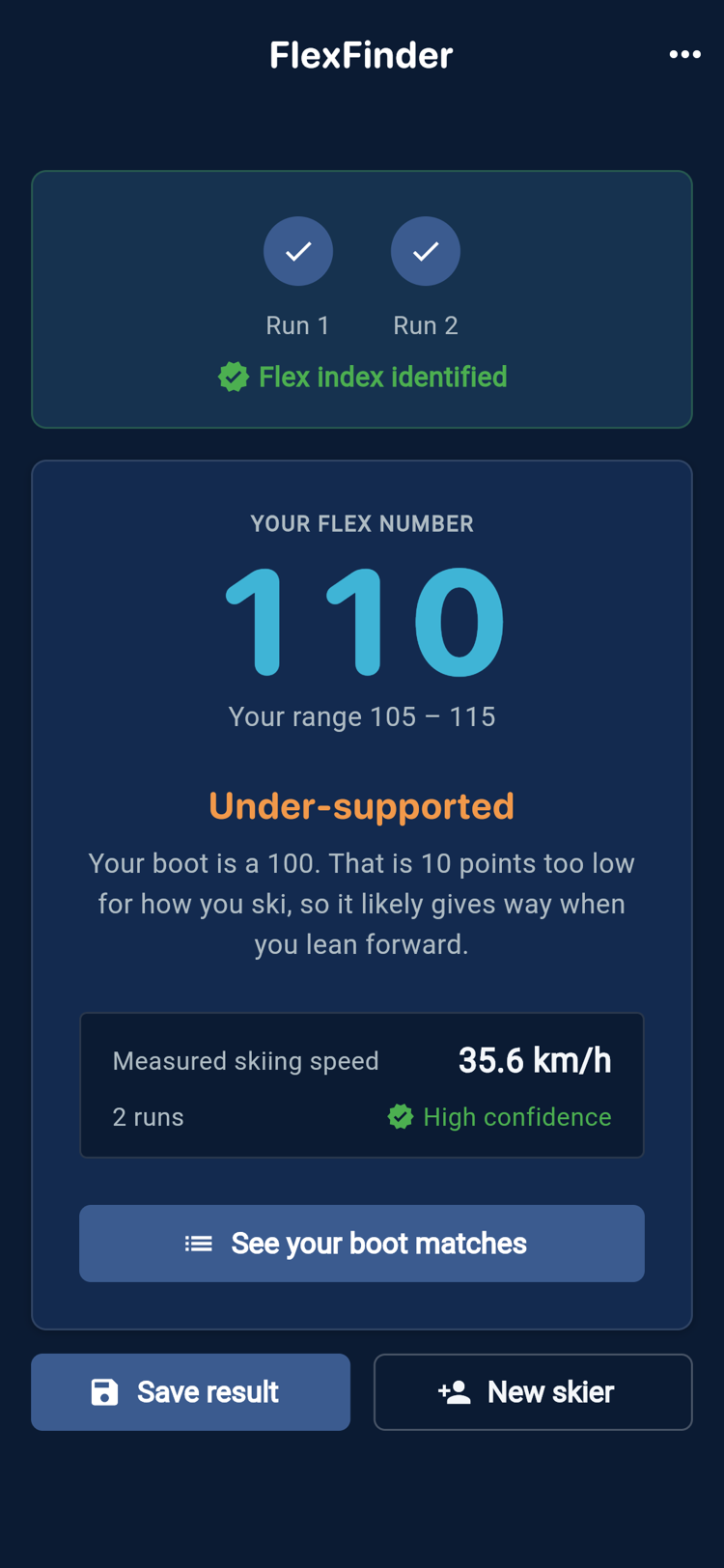
FlexFinder measures that. Pocket your phone, ski two to three runs, and you get one number: your flex index, for example 110. Then take the number to a bootfitter for the fit.
Read more: The number on your boot has no agreed test behind it · Fit or flex? Two things that go wrong with ski boots
What flex should a beginner ski boot have?
Charts by level give beginners a low range. Level is a poor guide: nobody rates it the same way, not even you.
A beginner still has a height and a weight, and the boot still has to keep them in balance. Your body is the same wherever you learned, so start from your number, not your label. A beginner's boot should also be more upright than an experienced skier's boot.
Read more: What's your level? Why it's so hard to answer in a ski shop · Why beginners quit skiing, and the part worth checking
Is there a ski boot flex chart by weight?
Some charts list weight, though most start from your level. None of the charts or boot finders we reviewed measure how you actually ski.
The number on a boot isn't standardised either, so the same number can mean different things from one maker to the next. FlexFinder asks for your height, weight and ski sidecut, then measures how you ski.
Read more: Tall or heavier? Why the same boot can feel different on you · The number on your boot has no agreed test behind it
What do 100, 110, 120 and 130 flex mean?
It's the boot's flex index. A boot with the right flex index keeps you in balance, front to back: when you bend your ankles forward, it turns that into pressure on the tip of the ski.
The number isn't standardised, so in the store you and your bootfitter try boots around your number. For a 110, that naturally means boots from about 105 to 115.
Read more: The number on your boot has no agreed test behind it · When it's flex: too low, too high, and how to tell
How does a ski boot flex calculator work?
FlexFinder asks for your height, your weight, your ski sidecut (the radius printed on the ski) and the flex index of your ski boots. Then go skiing. Any run you're happy on.
The app records your skiing with several of your phone's sensors, and a physics model calculates your number. It isn't exact to the last point, and it doesn't need to be: it's where you and your bootfitter start.
Read more: Why I built FlexFinder
Does FlexFinder tell me my boot size?
No. Length, width and shape are the fit, and a bootfitter handles that. FlexFinder gives you the flex index.
Bring both to the shop: your feet for the fitter, your number for the flex.
Read more: When it's fit: what the shape of a boot does to your feet · Fit or flex? Two things that go wrong with ski boots
I have wide feet or calves. Do I need a lower flex?
No. Bootfitters treat width and flex as two separate choices. Width and shape are for your foot. Flex is for your body and how you ski.
A roomy fit doesn't need a low flex number.
Read more: Myth: a low flex index is comfortable · When it's fit: what the shape of a boot does to your feet
Isn't a lower flex more comfortable?
Comfort comes mainly from fit: the width and shape of the boot. But a flex index that's too low for you can make a boot very uncomfortable, typically a rental boot.
A boot with a flex index that's too low for you doesn't support you when you lean forward. Your weight drifts back onto your heels, and your legs do the work. That just hurts.
Read more: Myth: a low flex index is comfortable · When it's flex: too low, too high, and how to tell
My ski boots hurt. Is the flex wrong?
Pain can come from flex, from fit, or from both. A flex index that's too low in a boot of the wrong size is the worst combination.
Burning thighs, cramping calves and the feeling that you're falling backwards can point to a flex index that's too low. Where it hurts tells you which one to look at first, and a bootfitter will know.
Read more: Fixing the wrong problem: why a lower flex index may not cure sore feet · When it's flex: too low, too high, and how to tell
How do I choose ski boots?
Three choices: the flex for your skiing, the fit for your foot shape, the forward lean for your position.
Get your flex number first. Then take the number to a bootfitter, who handles the fit. And keep taking lessons with a good instructor. Beginners are more comfortable in a more upright boot.
Read more: Fit or flex? Two things that go wrong with ski boots · Skis with a mind of their own? Six signs your boot may not be holding you