Where it hurts
It's lunchtime, and the first thing you do is open your buckles. Your toes ache, your arches ache, and there's that one spot you've felt since the first lift.
While you're still learning, the pain rarely comes alone. You feel out of balance, you curl up your toes to hang on, and you're afraid of falling.
Further along, your feet may hurt less, but a boot that lets them move around can still hold you back. You've stopped getting better, you stick to the same runs, and steeper slopes, hard, icy snow or deeper snow feel scary.
All of it is normal, and it's probably not you. A US ski-area trade magazine called getting the boot fit right the number-one stumbling block for beginners.
Most boot trouble I see is fit, flex, or both. This is the fit half. When it's flex covers the other.
Feet or thighs?
Pain in your feet is usually fit. Burning thighs and cramping calves are another story: they often point to a flex index too low for you.
Fit is the shape of the boot around your foot. The flex index is the number on it, and it's a separate choice. The right flex index keeps you in balance and puts your ankle bend into the tip of the ski, not into the boot.
What the shape is made of
- Length: how long the boot is for your foot.
- Width: how wide it is across the front of your foot.
- Volume: how much room there is overall.
- Instep: the room over the top of your foot.
- Heel pocket: the part that holds your heel down.
- Liner: the padded inner boot inside the hard outer shell.
I see it often: the padding in the liner wears flat with use, so a boot that fitted when it was new gets roomier over time.
When the boot is too roomy
At my bench, curled, gripping toes often mean a boot that's too big. With room to move, your toes grab to hang on.
In my experience, when your foot can move around inside, the boot can't hold you as well either. People struggle to find their balance, and they tense up.
Then, on steeper, icier or deeper snow, the ski can seem to live its own life and may not do what you ask. That's when it gets scary.
“A boot can only hold you if it holds your foot.”
That's why I say fit comes first. It isn't the only thing: technique, confidence and conditions matter too.
What a bootfitter does
At my bench, fit starts with a shell check: liner out, your foot in the bare shell, to see how much room there really is. From there, a fitter works on the shape where your foot needs it, so the boot holds your foot instead of hurting it.
One boot maker's expert puts it plainly: a bootfitter can usually sort out pain from your ankle bones, a bunion, a high instep or a low calf muscle.
What to do
Pain in your feet? See a bootfitter for fit first. A lower flex index may not cure sore feet.
Feet fine, but your thighs burn and the ski won't turn when you want it to? Check your flex index.
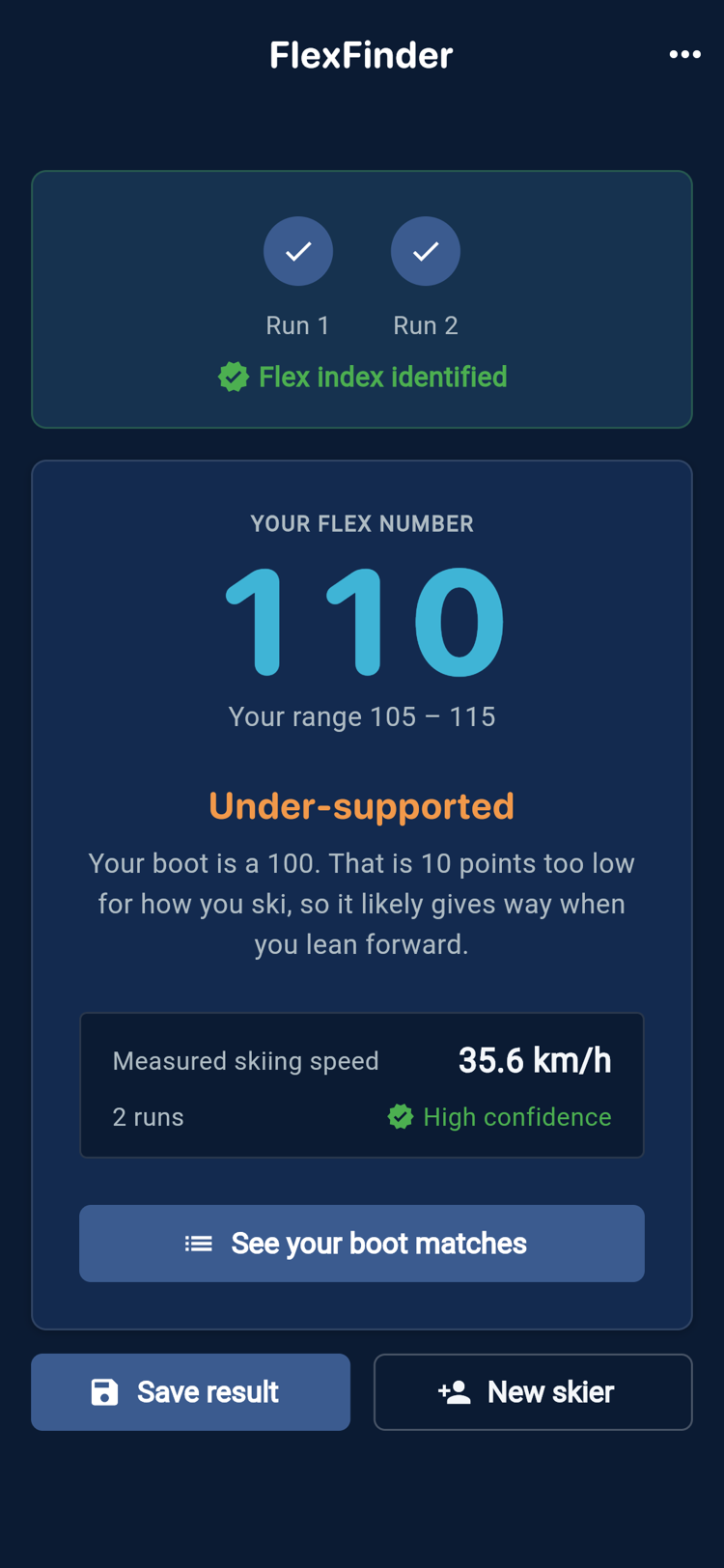
FlexFinder is an iPhone app that estimates it. Enter your height, your weight, your ski and the boot you have now, then ski two to three runs with the phone in your pocket.
You get a flex number and a range, a verdict on your boot, and matches from 229 boots across 11 brands. FlexFinder doesn't check fit, so treat the matches as a shortlist and try any match on with your fitter. It's an estimate, not a diagnosis.
And keep taking lessons. A good instructor, a good fit and the right flex index for your body all play their part in getting better.
In my experience, when the shape is right, your feet go quiet. The boot holds your foot without pinching, you find your balance, and you ski the whole day instead of counting the minutes until lunch.