Your feet hurt by lunch, and that's not all. Maybe you struggle to stay in balance, and you're afraid of falling. Maybe you've been stuck on the same runs for a while, and steep, icy or deep snow still scares you.
Then a friend who's skied for years has the answer ready: "Those boots are too much for you. Get a lower flex index."
It comes from a good place. In my experience, it often fixes the wrong problem.
Pain comes from two places
Pain in your feet usually comes from how the boot fits: its length, its width, the room over the top of your foot, and the liner, the padded inner boot. A lower number doesn't by itself give your foot more room, so that pain can stay. There's more on this in Fit or flex?.
- In your feet (toes, arches, pressure points, cold or numbness): look at fit first.
- In your legs (burning thighs, cramping calves): often a flex index too low for you.
When the number is too low
A boot with the right flex index keeps you in balance, front to back. When you bend your ankles forward, it turns that into pressure on the tip of the ski. The ski bends; the boot barely does.
Go too low, and when you lean forward the boot gives way instead of holding you. Your weight drifts back onto your heels, your thighs burn, and the front of the ski gets no pressure, so it won't turn when you want it to.
A boot too high for you fails as well: it stops you bending your ankles forward, so you end up leaning back and can't press the front of the ski. What you want is the right flex index for your body.
So if the swap goes too low for you, I think it makes things worse. While you're still learning, you can keep the sore feet and lose your balance as well: with nothing holding you forward, you tense up and brace for a fall.
In my experience, once you're past the basics, you feel it most when the slope gets steeper or the snow turns icy or deep: the boot gives way, and the ski lives its own life.
One skier's story
Another bootfitter wrote up a case like this. A skier with burning under the front of his foot had already tried a lower flex index, and it hadn't helped.
His boot's flex index was too low for him, and there was too little room over the top of his foot. The fix was fit and flex together: the right flex index, more room, footbeds (shaped insoles) and heel lifts (a small raise under the heel).
It's one case from one fitter, not a study. But the lower number didn't solve it. Fit and flex together did.
Where does it hurt?
- Feet? See a bootfitter. Fit is their job.
- Thighs and calves? Check the flex index for your body, not your level.
- Both? Then the fix needs both.
- Stuck or scared? A good instructor helps too; boots aren't the only cause.
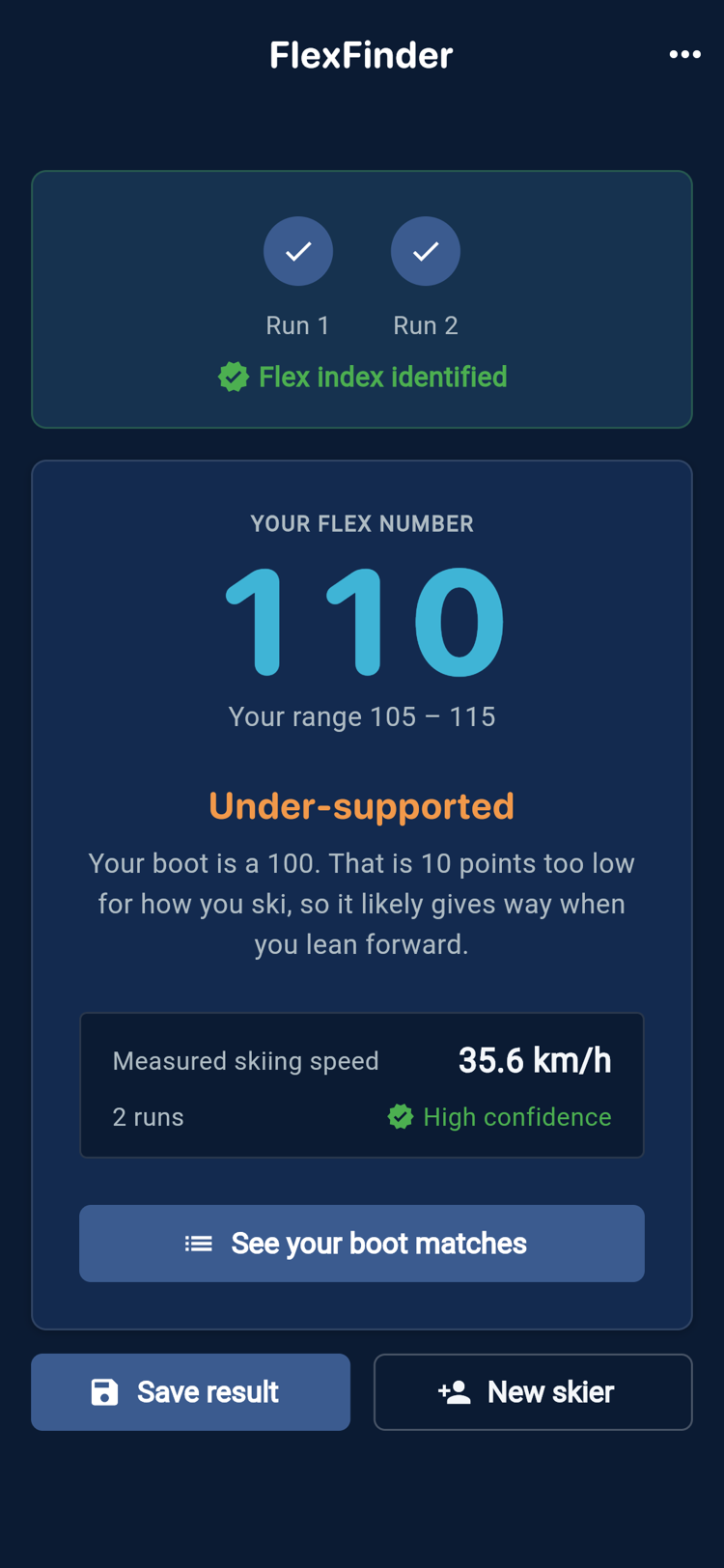
FlexFinder estimates your flex index. Enter your height, weight, ski and current boot in the iPhone app, then ski two to three runs with the phone in your pocket; runs count from 15 km/h.
You get a flex number and a range, a verdict on your current boot (too low, too high or right), and matches from 229 boots across 11 brands. Treat the matches as a shortlist to try on with your bootfitter. FlexFinder doesn't check fit, even for the boots it lists, and it isn't a diagnosis.
So before anyone changes the number, ask where it hurts. In my experience, once the fit is right the pain in people's feet usually eases, and once the flex index suits their body they stop fighting for balance.
Then the afternoon is for skiing again, not for counting the minutes until the boots come off. That's what fixing the right problem gives back.