One word at the counter
"So, what's your level?" You're standing in a ski shop in your socks, with one word to answer.
But you came in because of how skiing feels. Maybe you're new: your feet hurt, you curled up your toes to stay in balance, and you were afraid of falling. Or you've been stuck on the same runs for seasons: steeper slopes, icy snow and deep snow still scare you, and the ski doesn't turn when you want it to.
One word can't carry all that. Yet flex has long been sold by level, so that word can end up choosing the number on your boot. The boot isn't the whole story, but in my experience it's often part of it.
An easy question that isn't
It sounds like the easiest question in the shop. After years at the bench, I think it's one of the hardest. It's hard for you, and it's hard for the person helping you.
A Dutch study found that about four in five of the skiers it looked at rated themselves a little higher than the ski instructors watching them did. It's hard to see your own skiing from the inside.
And the words don't travel. At one US ski school, a "Level 3" skier still turns with the ski tips together and the tails apart. At a big Canadian one, Level 3 skiers already turn with their skis side by side.
In my experience, a beginner from Mexico and a beginner from Austria are not the same skier, even when both honestly say "beginner".
My bench has no slope
I can ask good questions, but I can't watch you ski. An instructor can.
So in the shop, your level comes down to a word you choose and a word I hear. I think that's a shaky place to start.
Your body is the same everywhere
“You don't choose ski boot flex by level. You choose it by physics.”
Your level depends on where you learned. Your height, your weight and how fast you ski don't. A kilo is a kilo in Mexico and in Austria, and so is a km/h.
Two skiers can both honestly say "beginner". One weighs 55 kg, the other 95 kg. In my view, the right flex index for their bodies isn't the same.
The right flex index keeps you in balance and puts your ankle bend into the tip of the ski, not into the boot. Too low or too high for your body, and you lose that balance and the ski won't do what you ask. More in When it's flex.
What to do next
- Answer the level question, then give more: where you learned, your days on snow, the runs you enjoy and the ones that scare you.
- Sore toes, arches or cold feet? That's usually fit. Ask your bootfitter.
- Keep taking lessons. A good instructor sees what no label can.
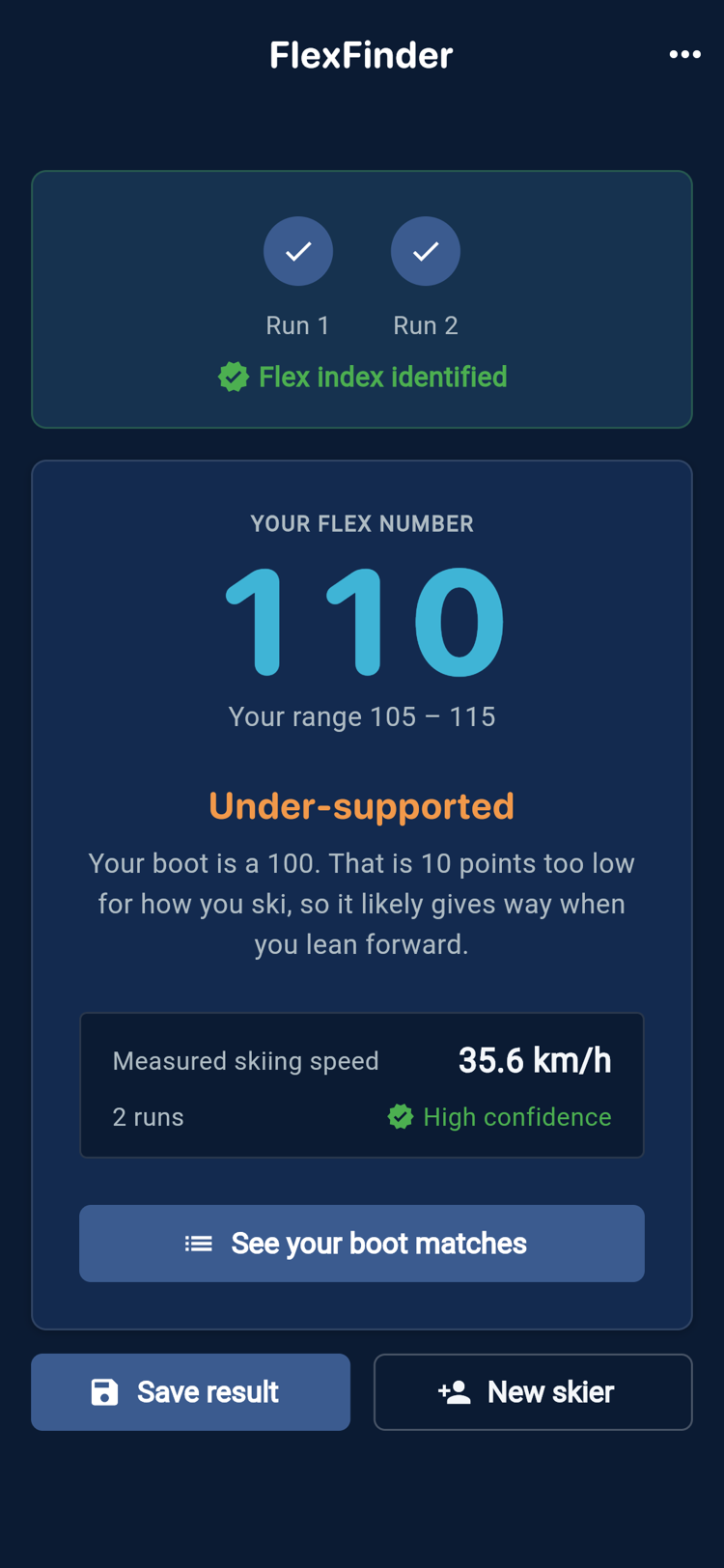
FlexFinder is an iPhone app. You enter your height, your weight, your ski and the boot you have now, then ski two to three runs with the phone in your pocket. It measures your speed and how hard you load each turn; runs count from 15 km/h.
After two to three runs you get a flex number and a range, a verdict on your current boot (too low, too high or right), and matches from 229 boots across 11 brands: a shortlist to try on with your bootfitter. FlexFinder estimates your flex index. It doesn't check fit, and it isn't a diagnosis.
Whatever your level is called where you learned, you want what everyone on the hill wants: feet that don't hurt, balance you can trust, a run you're proud of, then the next slope. In my experience, a boot that fits and holds your body is one part of getting there, and a good instructor is another. Skiglede, the joy of skiing, has no level.