At my bench
Grown-ups sit down on my bench with a boot half on. Most, by then, have decided the problem is them.
Beginners say it hurts and it's difficult to learn. They can't relax, they curl up their toes to keep their balance, the ski seems to live its own life, and they're afraid of falling.
Intermediates say they've stopped getting better. On steeper slopes, on hard, icy snow or in deeper snow it gets scary, because the ski doesn't turn when they want it to. I've written up the six signs they describe.
“Of the beginners and intermediates I measure, nine out of ten are on the wrong flex index for their body. Most often it's too low, especially if they are tall or heavier. That's what I see at my bench, not a study.”
After years of watching adults blame themselves for what I believe was often the boot, I wanted something better than my own good guess.
What the boot should do
The right flex index keeps you in balance and puts your ankle bend into the tip of the ski, not into the boot.
When it's too low for you, the boot gives way as you lean forward, and your push never reaches the tip of the ski. In my experience, that's one reason people tense up and stay on the runs they know.
Too high fails too: you can't bend your ankles forward. More in When it's flex.
Sore toes or pressure points are usually fit, and that's your bootfitter's job.
Sold by level, not by your body
Flex has long been sold by level. But your level depends on where you learned. A beginner from Mexico and a beginner from Austria are not the same skier.
A Norwegian study found that skiers' own ratings of their level matched a watched test run only loosely. A University of Innsbruck study found that the number printed on a boot only partly matched how the boot behaved on the slope.
So a label on the boot often gets matched to a label you give yourself. I think that's what's broken, not you and not your fitter.
Starting from how you ski
Your height, your weight and how fast you ski don't depend on where you learned. So instead of asking your level, I wanted the phone you probably already carry up the lift to record how you ski.
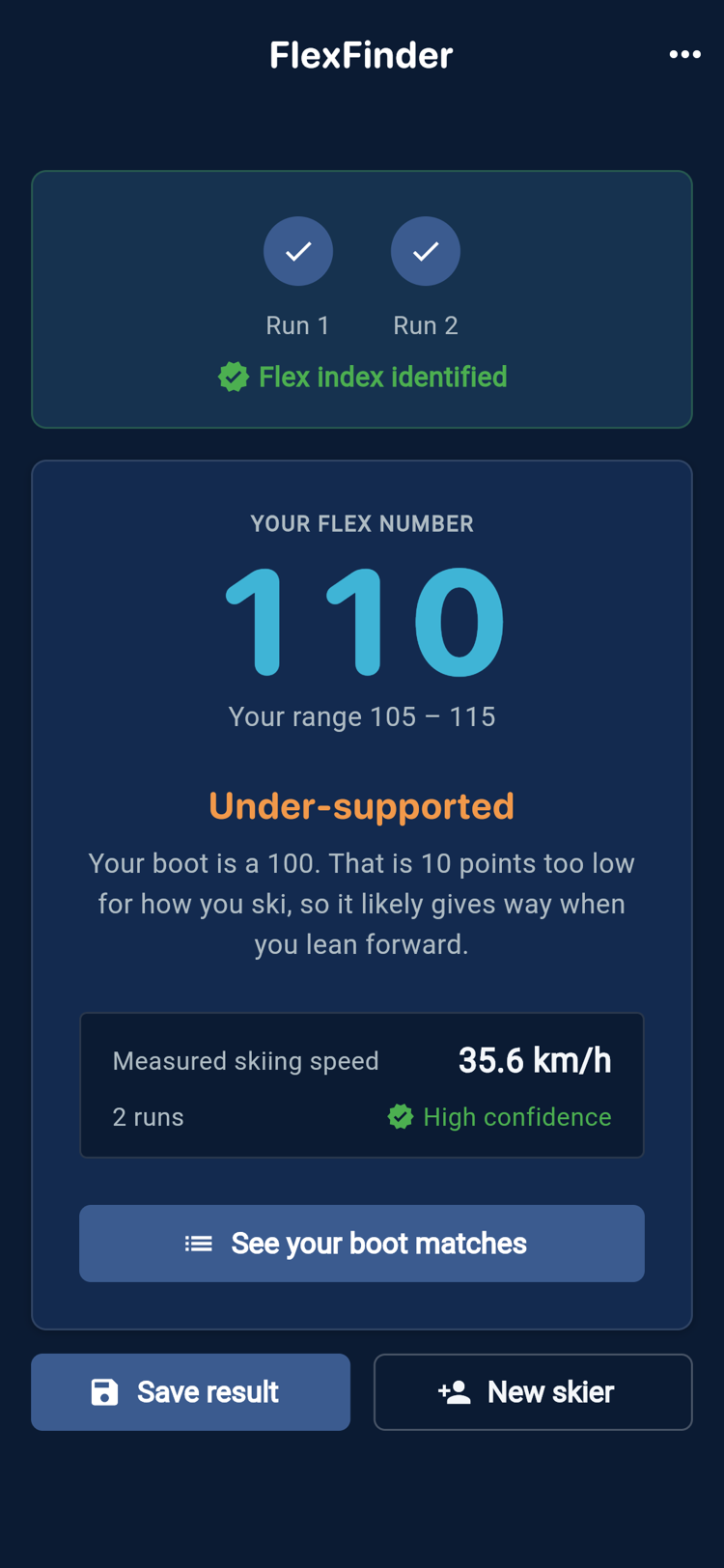
FlexFinder is an iPhone app. You enter your height, your weight, your ski and the boot you have now, then ski two to three runs with the phone in your pocket.
It spots each run on its own and measures your speed and how hard you load each turn. Runs count only from 15 km/h.
You get a flex number and a range, a verdict on your current boot (too low, too high or right), and matches from 229 boots across 11 brands. FlexFinder estimates your flex index. It isn't a diagnosis, and it doesn't check fit.
The matches are a shortlist to try on with your bootfitter.
I also work for a bootfitting business that sells boots. FlexFinder is separate from it: Snowhow sells no boots and takes no commissions. No brand pays to be on the list, and there are no affiliate links.
What to do next
It isn't always the boot: technique, confidence and conditions matter too. But the boot is worth checking.
- Take lessons from a good instructor.
- Let your bootfitter handle fit.
- Use FlexFinder to estimate the flex index for your body.
When the boot is right for the body in it, I've seen people find their balance, hurt less and try the slope they used to avoid, then come down it proud.
In Norwegian we call that feeling skiglede, the joy of skiing. Helping more people find it is why I built FlexFinder.