Close to giving up?
Maybe it hurt. Maybe you never found your balance, curled your toes to hang on, and spent the day afraid of falling.
If you're new and close to giving up, you're far from alone. The US ski areas association says only about 1 in 5 beginners in the US become regular skiers.
Or maybe you got past all that, then stopped getting better. You're stuck on the same runs, and steeper slopes, hard icy snow and deeper snow still scare you.
You probably have your reasons: cost, time, nobody to go with. Or a quiet feeling that you just weren't made for it. The fear is real and normal, and it may not be you.
Where to look first
Start with a good instructor. A US ski industry study found the instructor was the biggest single influence on beginners who stayed.
Then there's one part I think gets missed: the boot.
“When you're new, you have nothing to compare your boot with, so a boot that gives way can simply feel like what skiing is.”
What your boot should do
A boot has two jobs: keep you in balance, front to back, and press the front of the ski so it turns.
The right flex index for your body (the number on the boot) does both. When you bend your ankles forward, it turns that into pressure on the tip of the ski. The ski bends; the boot barely does.
When the number is too low for you, the boot gives way as you lean forward, your weight drifts back onto your heels, and the ski lives its own life. I explain how to tell in When it's flex. Too high is no better: you can't bend your ankles forward, so you end up leaning back.
As I see it, a boot that doesn't hold you makes the pain, the fear and the stuck feeling worse. With nothing holding you forward, you can't find your balance, you tense up, and the fear grows instead of fading. On steeper, icier or deeper snow, the ski won't do what you ask.
In my view, the boot is one reason people give up, not the only one; teaching, confidence and conditions matter too. But it's a part you can check.
Sore feet or burning thighs?
Pain in your feet (toes, arches, pressure points, cold or numbness) is usually fit: how the boot's length, width and shape match your foot.
Burning thighs, cramping calves and sore shins after leaning back all day often point to a flex index too low for you. A low number isn't comfortable: your thighs and calves end up doing the boot's work.
Before you stop
- Take lessons from a good instructor.
- Find someone to ski with.
- Ask your bootfitter to check the fit, especially if your feet hurt.
- Estimate your flex index with FlexFinder.
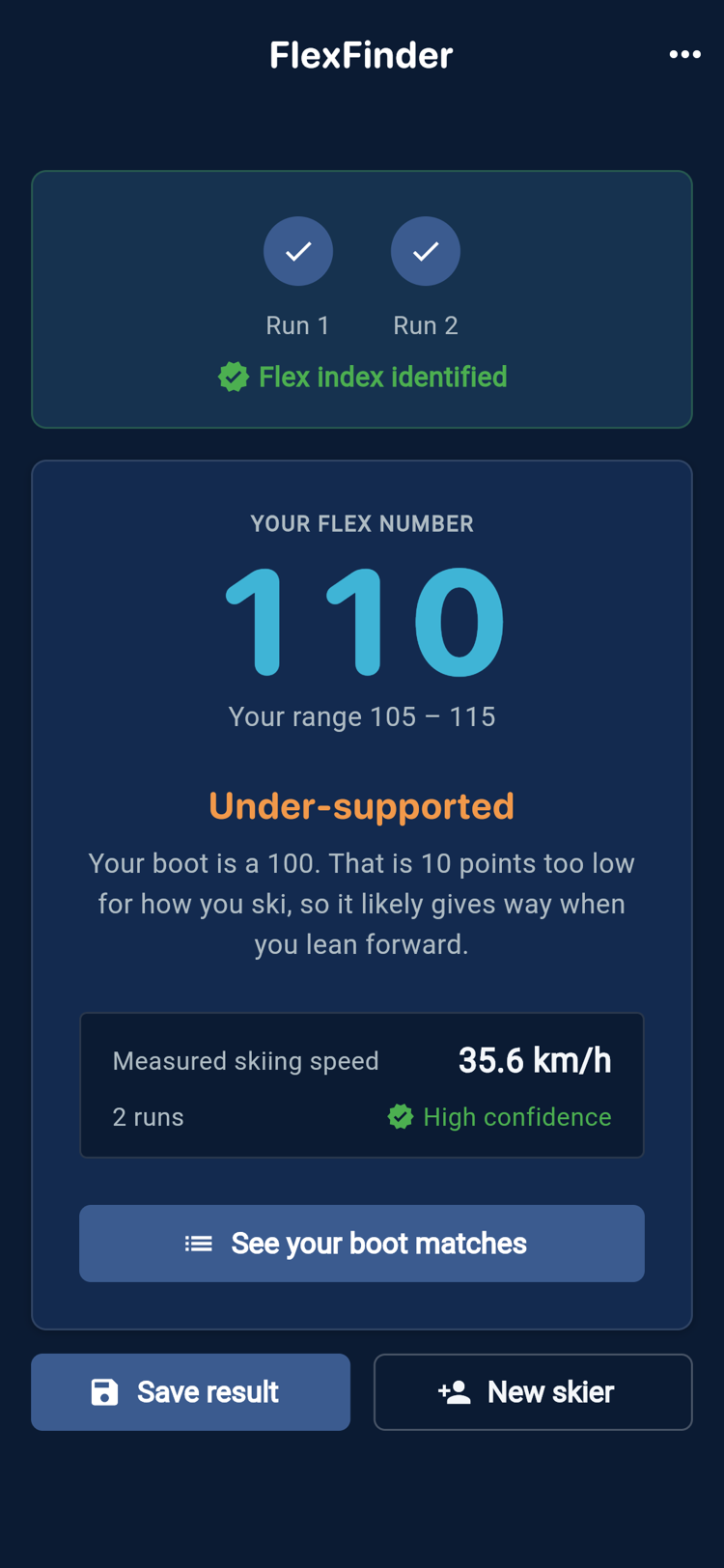
FlexFinder is an iPhone app. Enter your height, weight, ski and current boot, then ski two to three runs with your phone in your pocket; it spots each run on its own. Runs count only from 15 km/h, so if you're still slower than that, start with the first three steps.
You get a flex number and a range, a verdict on your current boot (too low, too high or right), and matches from 229 boots across 11 brands. Treat the matches as a shortlist to try on with your bootfitter.
FlexFinder estimates your flex index; it doesn't check fit, and it isn't a diagnosis. We sell no boots.
I can't promise you'll stay with skiing. But in my experience, when someone close to giving up gets a good teacher and a boot that fits and holds them, skiing starts to feel different.
Feet that don't hurt. Standing steady over the skis. A turn that goes where they meant it to. A run they're proud of. Then the next slope.
That's skiglede, the joy of skiing. Before you hang up your skis, give yourself one more try at finding it.