"I want something comfortable, so nothing with a high flex index." I hear that wish at my bench, and I understand it. Nobody wants a day in boots that hurt.
But a boot chosen for comfort by its number can let you down twice. Your feet may still hurt. And the boot may not hold you: a learner can feel out of balance and afraid of falling, while a more practised skier can stop getting better, and steeper slopes, hard icy snow or deeper snow can turn scary.
The wish mixes up two different things.
Comfort comes from fit
Pain in your toes or arches, pressure points, cold or numb feet: that's usually fit, how well the boot matches the length, width and shape of your foot. It's your bootfitter's craft, and a lower number may not fix it.
The flex index, the number on the boot, has a different job. The right one keeps you in balance and puts your ankle bend into the tip of the ski, not into the boot.
Fine in the shop, not on snow
On a shop floor, the floor can't bend, so when you lean forward the only thing that gives is the boot. A boot that holds you properly feels like too much on the carpet, so people pick a lower number.
On snow, it's the ski that should bend, and that's what turns you. A boot too low for you gives way before your push reaches the ski. Your weight drifts back onto your heels without you meaning to, and the front of the ski gets no pressure, so it won't turn when you want it to. By the end of the day your thighs can burn and your calves can cramp.
“A flex index too low for you isn't comfortable. It gives way, and your thighs and calves end up doing the work.”
What it feels like on the hill
While you're learning, a boot too low for you can feel like it gives you no support, forward or backward. Skiers tell me they can't relax, and they feel like they're falling backwards.
Once you're past the basics, you feel it when the run gets harder. You push harder, but that just bends the boot further, and the ski won't do what you ask. So you stay on the runs you know.
In my experience, a boot that doesn't hold you makes all of it worse. With nothing holding you forward, you feel out of balance, you tense up, and every turn feels like a fall waiting to happen. It isn't the only cause; technique, confidence and conditions matter too.
A roomy fit doesn't need a low number
If a roomy fit needed a low number, roomy boots would only come with low numbers. They don't. Of the 229 boots in FlexFinder's list, 58 have a flex index of 120 or more and come in a roomier width, 100 mm or more across the front of the foot.
So width and flex index are separate choices. That doesn't mean go high: too high, and you can't bend your ankles forward, so you end up leaning back. In my view, the flex index was never a comfort setting; match it to your body.
What to do
- Fit first, with your bootfitter.
- Then the flex index for your body, with FlexFinder.
- Keep taking lessons with a good instructor.
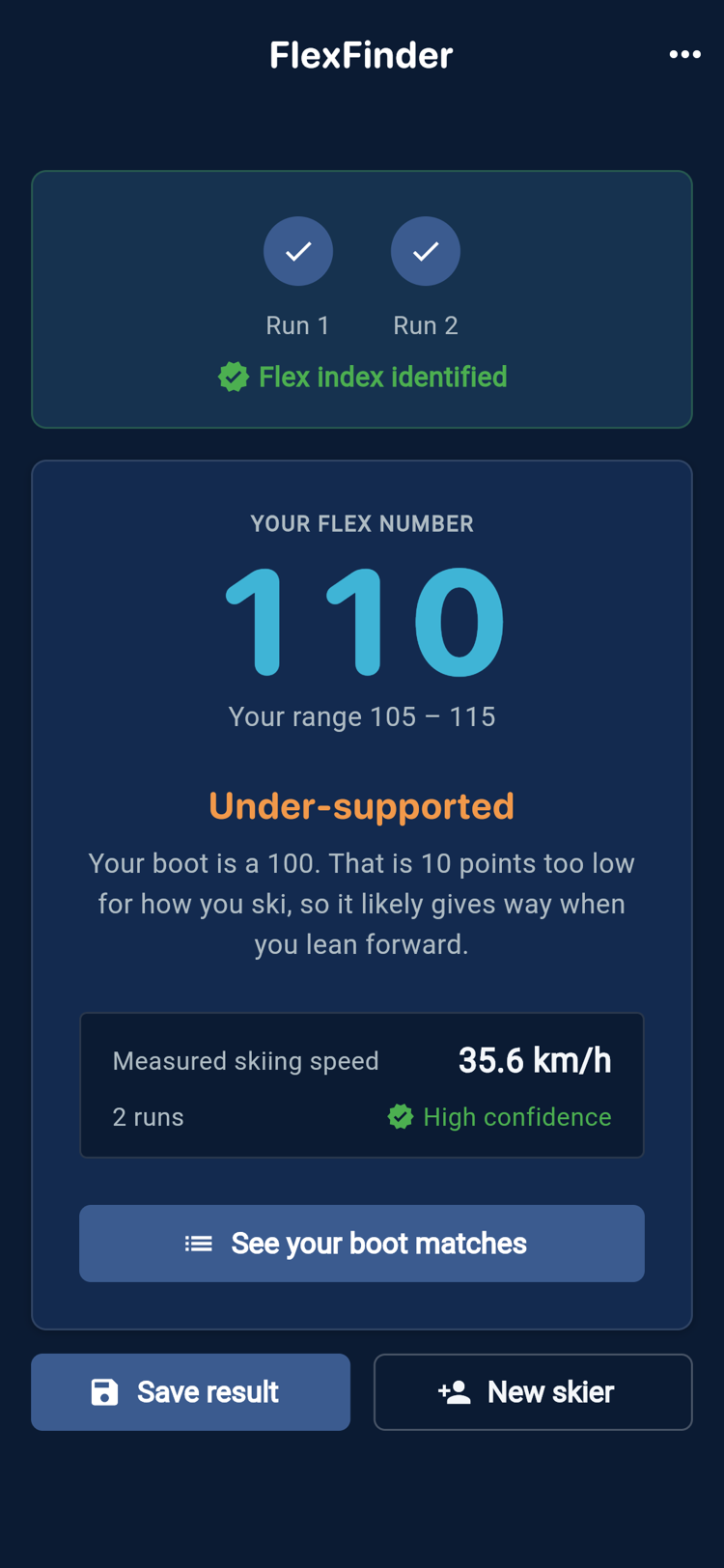
FlexFinder is an iPhone app. Enter your height, weight, ski and current boot, then ski two to three runs with the phone in your pocket (runs count from 15 km/h). It estimates your flex index and gives you a range, a verdict on your current boot and matches from 229 boots across 11 brands: a shortlist to try on with your bootfitter.
It doesn't check fit and isn't a diagnosis.
Don't ask one number to do two jobs. Let the fit bring the comfort, and the right flex index for your body bring the balance. In my experience, when both are right, people stop thinking about their feet and start looking at the next slope.