The number and what you feel
You probably chose your boot partly by that number. It looked like a clear answer. Then you got on the snow.
While you're learning, that can mean pain and no balance. Your thighs burn, you feel like you're falling backwards, and you curl up your toes to keep your balance. Being afraid of falling is normal.
Later on, the pain may fade, but the progress stalls. You're stuck on the same runs. Steeper slopes, hard, icy snow and deeper snow feel scary, and the ski seems to live its own life.
Technique, confidence and conditions all play a part. But in my experience, a boot that doesn't hold you makes all of it worse, and the number on the side can't tell you on its own whether yours does.
What the number is for
It's called the flex index, and the name misleads. The boot's job is to pass your push on to the ski, not to bend.
A boot with the right flex index keeps you in balance, front to back. When you bend your ankles forward, it turns that into pressure on the tip of the ski. The ski bends; the boot barely does.
Too low for you, and the boot gives way when you lean forward, so the ski won't turn when you want it to. Too high, and you can't bend your ankles forward, so you end up leaning back. When it's flex shows how to tell which.
No agreed test behind it
Researchers at the Technical University of Munich say there's no agreed test for ski boot flex. Without a shared test, makers have to set their own. So in my view, a 100 from one maker and a 100 from another aren't directly comparable.
A University of Innsbruck study measured the boots skiers wore on the slope. Higher numbers did tend to mean more support, just not tightly. But it found no clear difference between boots labelled 100 and 110, or between 80 and 90.
How I'd use the number
You don't choose ski boot flex by level. You choose it by physics. Your level depends on where you learned; your height, your weight and how fast you ski don't. If you're tall or heavier, the same boot can feel different on you.
- Treat the number as a rough guide, not an exact measure of how the boot will hold you.
- Compare boots from the same maker, and don't read much into a step of 10.
- Look for the right flex index for your body, not the highest or the lowest.
One warning about comfort. If your toes, arches or pressure points hurt, at my bench that's usually fit, and a lower number may not fix it. A low flex index isn't the comfortable choice it seems in the shop, either.
“The number on the side is a rough guide. Your body is where to start.”
What to do next
Find a good instructor, and let your bootfitter sort the fit. For the flex index, I built FlexFinder.
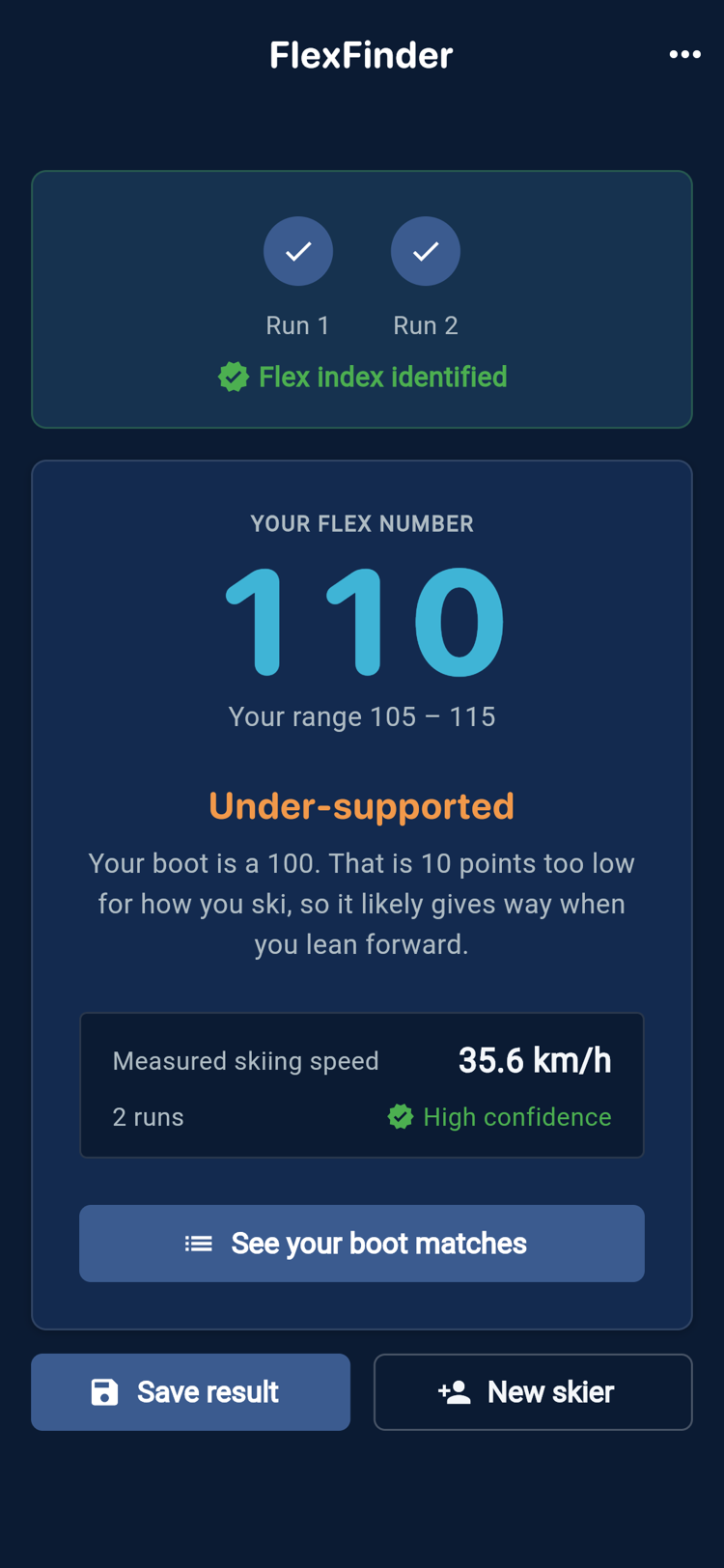
It's an iPhone app. Enter your height, your weight, your ski and the boot you have now, then ski two to three runs with the phone in your pocket. It measures your speed and how hard you load each turn; runs count only from 15 km/h.
You get a flex number and a range, a verdict on your current boot (too low, too high or right), and matches from 229 boots across 11 brands. Treat them as a shortlist to try on with your bootfitter, not a final answer.
FlexFinder estimates your flex index. It doesn't check fit and isn't a diagnosis. Your fitter is on your side, and so are we.
So start from your body, not the label. In my experience, when the flex index is right for the body inside the boot, and there's a good instructor and a good fit too, people find their balance and start getting better. They stop second-guessing the number on the side and start trusting their balance.