"My boots hurt." "My boots don't hold me." Skiers bring me both.
Behind those words are real pains: sore feet, feeling off balance, being afraid of falling, or being stuck on the same runs while steeper, icier or deeper snow still scares you.
In my experience, most boot trouble comes down to fit, flex, or both, and the two often get mixed up. It's probably not you.
Fit is the shape
Fit is how the boot's shape matches your foot: length, width, room inside, how it holds your heel, and the liner, the padded inner boot.
When fit is wrong, you feel it in your feet: squashed toes, aching arches, pressure points, cold or numb feet, a heel that lifts. Most foot pain comes from fit, not from the number on the boot.
Flex is what holds you
The flex index is the number on the boot. A boot with the right flex index keeps you in balance, front to back.
When you bend your ankles forward, it turns that into pressure on the tip of the ski. The ski bends; the boot barely does.
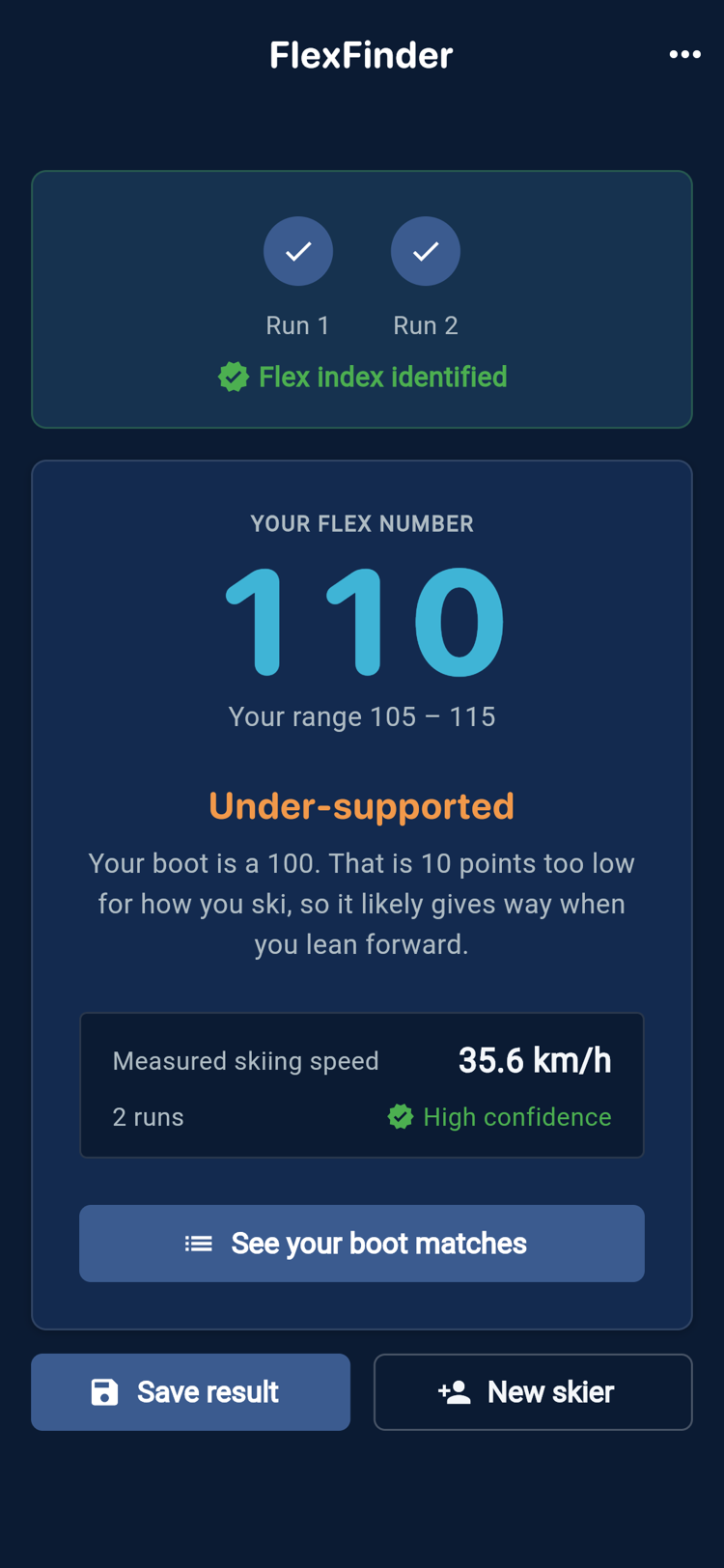
When the flex index is too low for you, you feel it in your legs. You lean forward and the boot gives way instead of holding you. Your weight drifts back onto your heels, your thighs burn, and the front of the ski gets no pressure, so it won't turn when you want it to.
In my experience, a boot that gives way makes the fear worse. With nothing holding you forward, you tense up and ski braced for a fall. On steeper, icier or deeper snow, the ski lives its own life, and it gets harder to get better. The boot isn't the only cause; technique, confidence and conditions matter too.
A number too high for you goes wrong the other way: you can't bend your ankles forward, you end up leaning back, and you can't press the front of the ski.
Which one is it?
A rule of thumb (more in the six signs):
- Pain in your feet: start with fit.
- Burning thighs, cramping calves: check your flex index.
- The boot gives way when you lean forward: maybe too low.
- You can hardly bend your ankles: maybe too high.
Some signs can be either. If you curl your toes to keep your balance, the boot may be too big for your foot, or it may be giving you no support. Your bootfitter can tell which.
Fix the right one
“A lower flex index won't fix a fit problem, and a better fit won't fix a flex problem.”
That's my rule from the bench. A German sports-safety foundation warns that a boot that's too big for your foot also holds you less well. So I'd start with fit.
But a boot can fit well and still have the wrong flex index for your body, and then it still won't hold you. Not the lowest number, not the highest: the right one for your body.
What to do
Fit: your bootfitter. Take the pain to them first.
Flex: FlexFinder estimates your flex index. It's an iPhone app: enter your height, weight, ski and current boot, then ski two to three runs with the phone in your pocket. You get a flex number and a range, a verdict on your boot (too low, too high, or right), and matches from 229 boots across 11 brands.
It's an estimate, not a diagnosis, and it doesn't check fit. The matches are a shortlist to try on with your bootfitter, who puts the two halves together.
And keep taking lessons. A US ski industry study found the instructor was the biggest single influence on beginners who stayed.
So fix what's actually wrong, and sometimes that's both. In my experience, when people do, a better fit eases sore feet and the right flex index helps them stop bracing and find their balance. Once they trust their boots, they stop skiing to survive and start skiing to get better.