Same boot, different body
The lighter friend relaxes, and the skis turn when they ask. The bigger one leans forward, feels the boot give way, and never quite finds their balance.
Early on, the bigger friend's thighs burn, they wobble, and they're afraid of falling. A few seasons later, they've stalled: the same runs every trip, and steeper slopes, hard icy snow and deeper snow feel scary.
Maybe you're that friend. Fear is normal, and it's probably not you. It may be the boot.
Of the beginners and intermediates I measure, nine out of ten are on the wrong flex index for their body. Most often it's too low, especially if they are tall or heavier. That's what I see at my bench, not a study.
What the boot should do
A ski boot has two jobs: keep you in balance, front to back, and press the front of the ski so it turns. The right flex index keeps you in balance and puts your ankle bend into the tip of the ski, not into the boot.
If the number is too low for your body, the boot gives way instead of holding you. In my experience, with nothing holding you forward, you tense up, and on steeper, icier or deeper snow the ski lives its own life. When it's flex explains how to tell.
Sore toes and pressure points are a different problem: usually fit, and a job for your bootfitter.
Why your size matters
Stand up and lean forward from your ankles. You'll feel your calves tighten to stop you tipping over. In a ski boot, the front of the boot can share that work.
Balance researchers use a simple model of someone standing still, not skiing: at the same lean, the heavier you are, the more weight leans out over your ankles, and the taller you are, the higher that weight sits, like a longer lever.
My own reading: at the same lean, a bigger body asks more of the same boot. In a boot too low for you, a bigger body simply bends the boot further before anything reaches the ski.
Your body, not your label
You don't choose ski boot flex by level. You choose it by physics. Your level depends on where you learned; your height and weight don't.
Flex has long been sold by level, and I think that's where it goes wrong. Choose by level alone, and a 55 kg beginner and a 95 kg beginner start from the same range of numbers.
A German sports-safety foundation advises that the sportier your skiing and the heavier you are, the higher the flex index should be. That means the right number for your body, not the biggest one: too high, and you can't bend your ankles forward, you end up leaning back, and you can't press the front of the ski.
“Being tall or heavier isn't a problem to fix. It's information your boot choice should use.”
What to do
The boot isn't the only cause. Technique, confidence and conditions matter too.
- A good instructor for technique and confidence.
- Your bootfitter for fit.
- FlexFinder for the flex index.
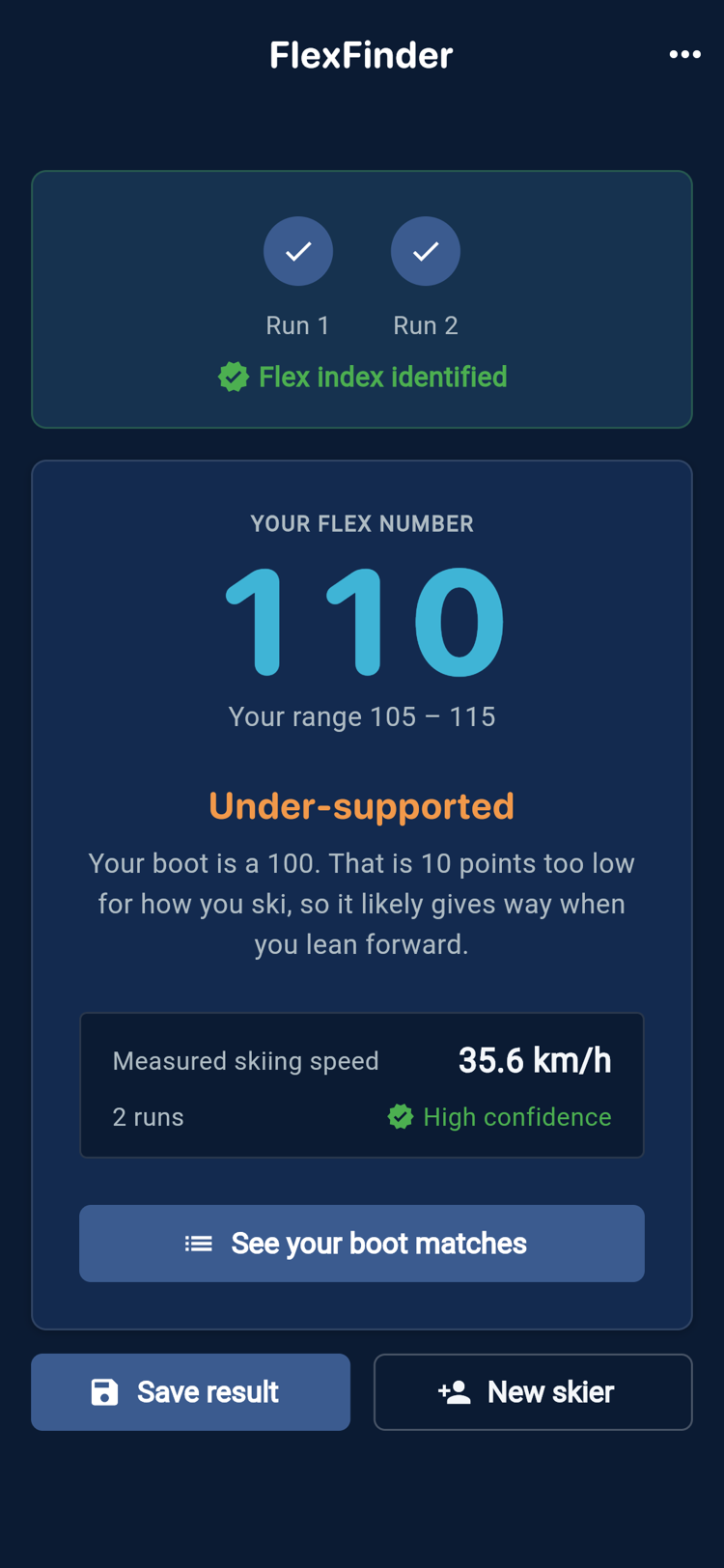
FlexFinder is an iPhone app. Enter your height, weight, ski and current boot, then ski two to three runs with the phone in your pocket. It spots each run on its own and measures your speed and how hard you load each turn; runs count from 15 km/h.
You get a flex number and a range, a verdict on your boot (too low, too high or right), and matches from 229 boots across 11 brands: a shortlist to try on with your bootfitter. It estimates your flex index; it doesn't check fit, and it isn't a diagnosis.
Think back to the two friends. In my experience, when a taller or heavier skier gets a good fit, good teaching and a boot with the right flex index for their body, the fight for balance eases, their legs last the whole day, and some mornings they're the one pointing at the steeper run.