Your thighs are burning by the third run. You lean into the turn, and the ski carries on straight.
Maybe you're still learning: it hurts, you can't find your balance, and you're afraid of falling. Or you've skied for a while and stopped getting better: stuck on the same runs, tensing up when it gets steep, icy or deep. I hear both at my bench.
In my experience, a boot that doesn't hold you makes all of this worse. With nothing holding you forward, you're off balance and can't press the front of the ski, so you tense up. Technique, confidence and conditions matter too, and being scared is normal.
What the boot should do
A ski boot has two jobs: keep you in balance, front to back, and press the front of the ski so it turns. With the right flex index, the boot turns your ankle bend into pressure on the tip of the ski. The ski bends; the boot barely does.
Too low: the boot gives way
When you lean forward, the boot gives way instead of holding you. Your weight drifts back onto your heels without you meaning to, your thighs burn, and the front of the ski gets no pressure, so it won't turn when you want it to. The ski lives its own life.
In the right boot, your shin angle in the turn stays the same and your pressure changes. That's what bends the ski tip and turns you. In a boot too low for you, pushing harder just bends the boot further, and the tip gets nothing.
Too high: not far enough forward
You try to bend your ankles forward, and the boot won't let you go far enough. You can end up leaning back, and it's hard to press the front of the ski.
My view: not the lowest number, not the highest, but the right flex index for your body.
Too low, too high, or fit?
Watch what the boot does when you lean forward. These are clues, not a diagnosis.
- The boot gives way, and your thighs and calves do the work: often a flex index too low for you.
- The boot won't let you bend your ankles far enough forward: it may be too high for you.
- Your toes or arches hurt, or your feet go cold or numb: usually fit. More in Fit or flex?
- You curl your toes to keep your balance: usually fit, most often a boot that's too big. A boot that's too big can also stop you getting forward.
“If your feet hurt, start with the fit. If the boot gives way when you lean, or won't let you get far enough forward, check the flex too.”
What I see at my bench
Of the beginners and intermediates I measure, nine out of ten are on the wrong flex index for their body. Most often it's too low, especially if they are tall or heavier. That's what I see at my bench, not a study.
Where it's too low, I think the comfort myth is often behind it.
What to do
Keep taking lessons: a good instructor matters. For fit, see your bootfitter.
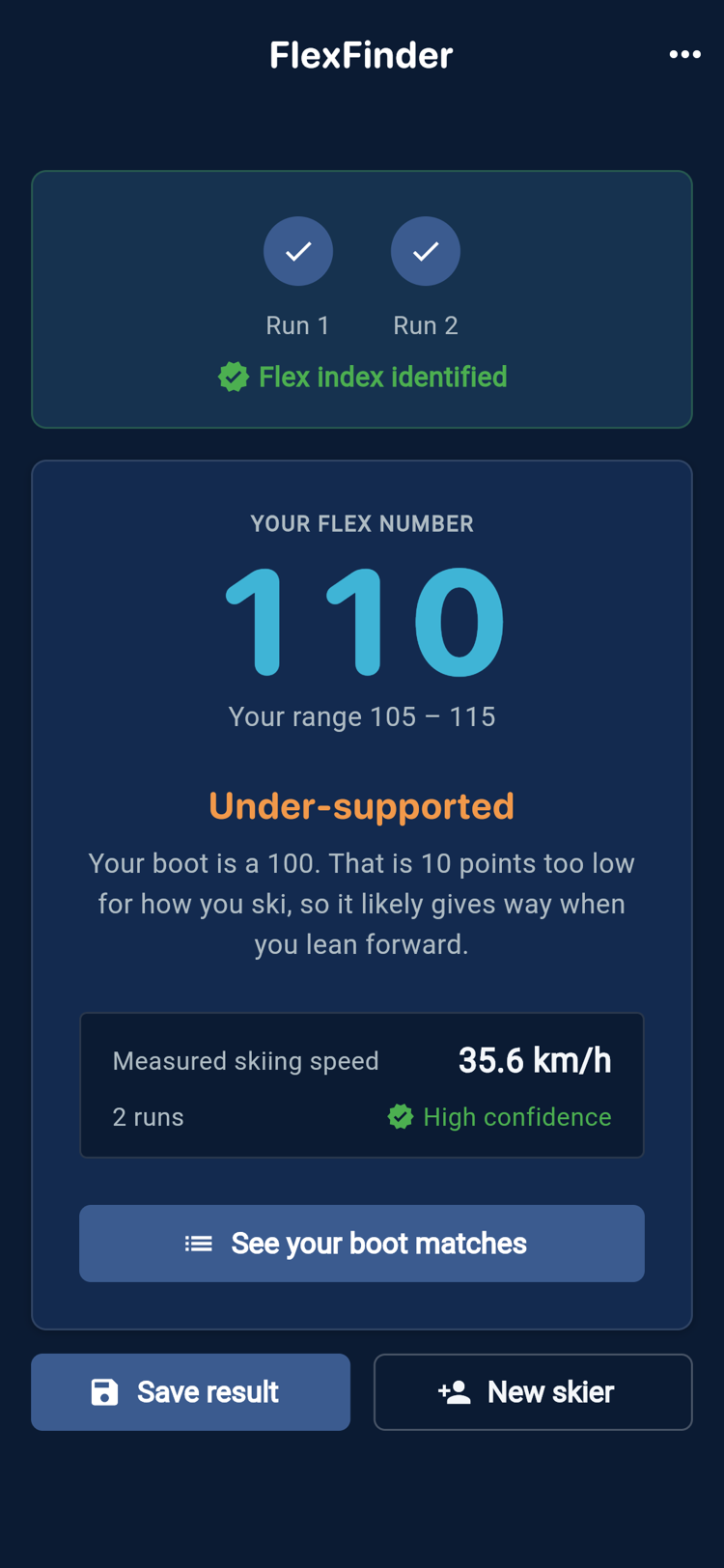
For the flex index, there's FlexFinder, an iPhone app. Enter your height, weight, ski and current boot, then ski two to three runs with the phone in your pocket. It measures your speed and how hard you load each turn.
You get a flex number and a range, a verdict on your boot (too low, too high, or right), and flex matches from 229 boots across 11 brands. FlexFinder estimates your flex index. It isn't a diagnosis, and it doesn't check fit, so treat the matches as a shortlist to try on with your bootfitter.
The app gives you an estimate, nothing more. In my experience, the change comes when the boot fits and holds people: they stop tensing up, find their balance, and the ski starts turning where they ask it to.